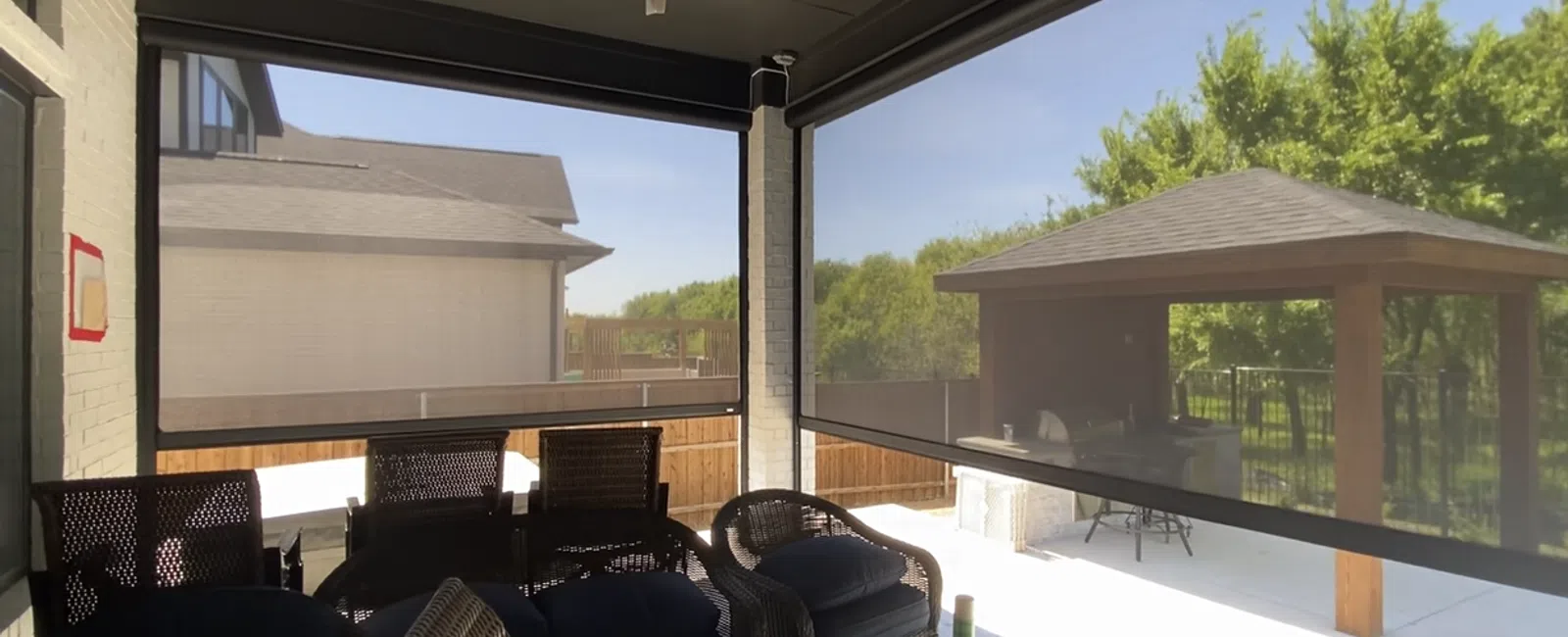
Solar mesh is rated by openness, a percentage that describes how much of the weave is gap rather than yarn. That one number does most of the work on a patio. It sets how much sun gets stopped, how much of the yard you can still see, and how much air moves through. Outdoor roller shades for patio use come in roughly 1 percent through 14 percent, and picking the wrong end of that range is the most common reason a shade gets installed and then never gets used.
Two other things decide the job, but don't show up on a product page: how much wind the patio takes, and whether there is power where a motor would go.
Openness Is the Whole Decision
A lower percentage means a tighter weave, more sun blocked, and a softer view. A higher percentage means more light, more airflow, and a view that stays sharp. Neither end is better. It depends on which direction the patio faces and what time of day people actually sit out there.
| Openness | What it does | What it suits |
|---|---|---|
| 1% | Blocks the most sun and gives the most privacy. The view goes soft. | West facing patios with no relief in the afternoon, or a patio close to a neighbor's yard |
| 3% | Cuts glare hard while keeping the view readable. The usual default. | A common middle setting on covered patios |
| 5% | Noticeably brighter with more airflow through the weave. | East and north facing patios, or anywhere the sun is already partly blocked |
| 10% to 14% | Keeps the view almost intact and takes the edge off glare. | Shaded patios where the goal is comfort rather than sun control |
Fabric color changes the result as much as the percentage does, and it works backwards from what people expect. Darker mesh absorbs light instead of bouncing it around inside the weave, so the view through it stays crisp and glare drops. Lighter mesh reflects more heat off the face of the shade, but it scatters light within the weave and the view goes milky. Neither is automatically the better call, and it is hard to judge from a photo, so it is worth seeing the color options against the light the patio actually gets.
Wind Is What Breaks Them
A shade that hangs free at the bottom moves in wind, and a North Texas spring storm moves it a lot. Every system carries its own wind rating, and that number is the one to ask for on the specific product being quoted. Past whatever it is, the fabric flexes against the brackets and the hem bar swings into whatever is beside it.
The fix is holding the sides, and there are two common ways to do it. A cable guide runs a tensioned wire down each edge through the hem bar, which suits a patio with some protection around it. A side track captures the fabric edge in an aluminum channel, which is the sturdier option for exposed patios and wide openings. Track systems cost more and they need square, plumb posts to fasten to, so a patio with round columns or stone veneer changes the plan. The posts are worth looking at before the fabric, because fabric is the easy decision and hardware is where the job actually gets settled.
Power Is the Question Nobody Asks First
Motorized exterior shades are worth it on a patio more than almost anywhere in the house, because the shade is fifteen feet away from where you sit and nobody gets up to crank it. We went through the cost side of that in our look at where motorization pays off. The catch on a patio is electricity. If there is already a ceiling fan box or an outlet overhead, the install is simple. Plenty of covered porches have nothing up there at all.
Battery tube motors solve that without an electrician, at the cost of recharging on whatever interval the motor calls for. Hardwired motors need a circuit run to the mounting location, which means an electrician and a wall or soffit that can be opened. Hand crank gear operation is still made and still works, and on a single shade over a small porch it is often the right answer.
Screened Porches Are a Different Problem
A screened porch already has bug protection and usually some shade, so porch roller shades there are doing one job: stopping low sun that comes in under the roofline and across the screen. That means the shade only has to cover the lower portion of the opening on the sun side, not the whole porch. Mounting outside the screen frame rather than inside it keeps the shade clear of the screen and lets it roll without catching. Outdoor roll up shades for porch openings also tend to run narrower than patio spans, which puts them back inside single panel width limits and keeps the hardware simpler.
Pergolas run the other direction. There is no solid roof overhead, so sun comes through the slats as well as in from the side, and a shade on the sun-facing side only solves part of it. Outdoor kitchens add their own wrinkle, since heat from a grill wants to go up and out, and a shade pulled tight across an opening can hold it in. Both are worth walking through in person rather than ordering off a measurement.
What the Brackets Land In
Interior shades land in wood framing behind drywall. Exterior shades land in whatever the patio is built from, and that varies more than anything indoors. A wood header under a covered patio is the easy case. Stucco over foam needs anchors long enough to reach the structure behind it. Brick veneer needs sleeve anchors set in the brick rather than the mortar joint. Metal patio covers need self-tapping screws and a check that the panel is thick enough to hold a loaded shade. The weight matters here in a way it does not on a bedroom window, because a wide exterior patio shade plus a motor and a track system is a real load hanging over furniture.
Questions We Get on Patios
What openness should I pick for a west facing patio?
One or three percent. West exposure in Dallas means direct low sun from about four o'clock through sunset in summer, which is the hardest light to block and the time most people want to be outside. A five percent fabric will feel like it is not doing anything at that hour.
Do outdoor shades hold up in wind?
A free hanging shade handles normal breeze and should be rolled up ahead of a storm. If the patio is exposed or the shade is wide, a side track or cable guide system is what makes it stay put. We would rather sell a track than replace a shade.
Can people see in at night?
Yes, and this reverses after dark. Solar mesh works by being brighter on one side, so during the day you see out and nobody sees in. Once the patio lights come on and the yard goes dark, that flips and silhouettes are visible from outside. A lower openness reduces it. Nothing eliminates it except a solid fabric.
Do patio shades actually cool the patio down?
They stop direct sun from hitting you and from heating the surfaces around you, which is most of what makes a patio uncomfortable. They do not cool the air the way a fan does. The bigger effect is often indoors, since a shade pulled across a patio also shades the glass behind it, which takes load off the room inside. That is a different job from light filtering roller shades on the inside of that same glass, and the two work well together.
How long do they last outside?
Solar mesh is built to take UV, so the parts that tend to go first are the moving ones, particularly on a shade left down through storms. Rolling it up when the patio is not in use takes that wear out of the equation. Expected life varies by system, so it is worth asking what the warranty covers on the one being quoted.
Preference Comes Last
Direction the patio faces, then openness, then wind exposure, then power. Four answers and the product is mostly decided. With outdoor roller shades for patio spaces, fabric color and hardware finish come after that, and those are the fun part. We install these across Dallas, Fort Worth, and the suburbs, and the patios that end up getting used every evening are the ones where somebody checked the sun angle before ordering rather than after.
Let Us Look at the Patio First
We look at which way the patio faces, what the posts and header are actually built from, and whether there is power where a motor would go. Those four answers settle most of the product before anything gets ordered. Set up a free in-home measure and we will come to you.