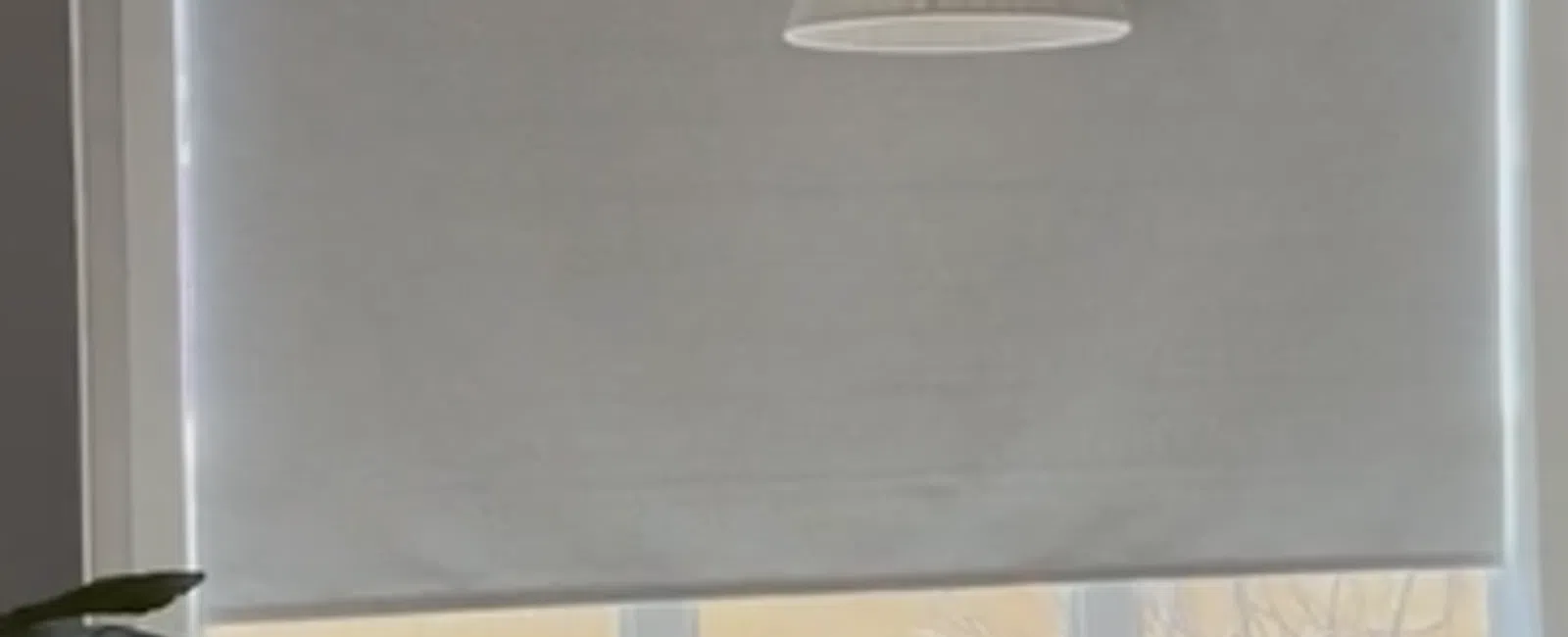
Every blind and shade has a width it can be built to, and past that point the manufacturer stops warranting it. So a ten foot living room window actually has fewer options than a bedroom window, not more.
How wide the opening is decides how many panels you get. How heavy the panels are decides whether the lift can stay cordless. We work both of those out at the measure, before anyone starts looking at fabric.
Width Caps Decide the Layout
Every product has a point where the mechanism stops working reliably at full span. Limits vary by manufacturer and product line, and the number that matters is the one for the specific product being ordered, but the pattern below holds across most of what we install.
| Treatment | Typical single-panel width limit | What happens past the limit |
|---|---|---|
| 2 inch faux wood blinds | Around 96 inches | Weight makes cordless lift hard to operate, and the slats start to bow at the center |
| Roller shades | Around 108 to 144 inches | The fabric can telescope on the tube and track off to one side |
| Cellular shades | Around 144 inches | The headrail deflects and needs a center support that stays visible |
| Plantation shutters | Around 36 inches per panel | The opening gets divided into multiple panels with a post between them |
| Draperies | No practical limit | A split draw or a motorized track handles any width we have measured |
When an opening runs past the cap, the treatment gets split into two or three panels on one headrail. They operate independently and they look intentional if the split lands in the right place. We line the split up with an existing mullion or with the center of the window whenever the framing allows it.
Weight Is What Ends the Cordless Conversation
A cordless lift works by balancing a spring against the weight of the blind. That balance holds fine on a bedroom window. On a wide 2 inch cordless faux wood blind, the stack of slats gets heavy enough that raising it takes both hands and real effort, and the shade starts drifting back down on its own within a year or two.
This is the honest case for motorization on big openings, and it has nothing to do with gadgetry. A motor lifts a heavy panel as easily as a light one. We got into the cost side of that in our look at where motorization pays off, but once a window gets past about eight feet wide, a motor is not really an upgrade anymore. It is what makes the shade usable at all.
Height creates the same problem in a different way. Blinds for tall windows have to be operated from somewhere, and two story great rooms are everywhere in newer Prosper and Southlake construction, where a shade sixteen feet up cannot be reached from the floor. A wand or a pole works until somebody gets tired of it. We have replaced a lot of manual treatments in those rooms with motorized draperies and motorized shades, usually about three years after the house was finished.
Bay Windows Are Three openings, Not One
Window treatments for bay windows go wrong when the bay gets treated as a single unit. It is three or five separate openings meeting at an angle, and the angle is where the trouble is. Inside mounting each section keeps the treatments clear of each other and lets the trim show, which is usually what a bay is there to do. Outside mounting across the whole bay means the panels collide in the corners unless the returns are cut back, and the corner detail is fussy on plantation shutters specifically, because the frames meet at something other than ninety degrees.
The depth in a bay is often shallower than it looks, since the sash sits close to the trim on a lot of builder-grade bays. We check each of the three sections separately, because they are frequently not the same depth. If one section comes up short, light filtering roller shades need less room than almost anything else and can save the layout.
Arched and Specialty Tops
Window coverings for arched windows split into two decisions: whether the arch needs to operate, and whether it needs to match the window below it. A fixed sunburst shutter or a stationary fabric insert covers the arch permanently, costs less, and never breaks. An operable arch treatment exists, but the hardware is complicated and it costs a lot more.
Most of the arches we cover are high up and facing west, where the job is blocking afternoon sun rather than providing privacy. A fixed treatment handles that. We only recommend an operable arch when the window is low enough that somebody can see in through it.
Book a Free In-Home Measure
We measure the span, work out where the splits fall, and tell you what the opening will hold before anything is ordered. We bring samples, and we bring the ladde. Set up a visit and we will come out to you.